The best dual monitor arms depend on screen size and weight, desk construction, and whether you want side-by-side or stacked displays. These picks cover compact screens, heavier ultrawides, taller positioning, and built-in USB charging, so check each mount’s compatibility before choosing.
Quick Top Products
HUANUO HNDS7 Dual Monitor Stand
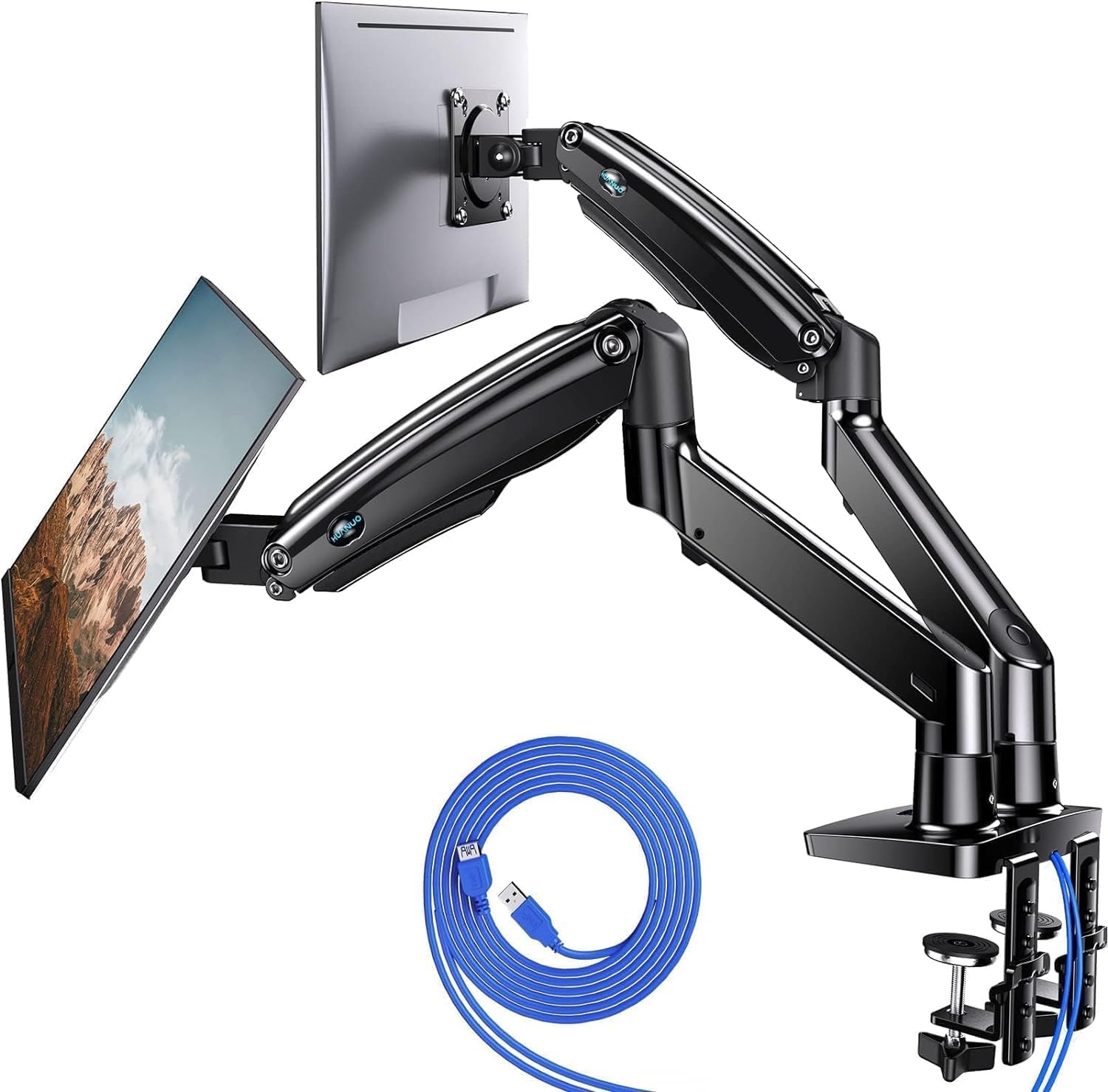
- Fits two 13–40-inch screens up to 26.4 lb per arm.
- Raises up to 21.1 inches and extends up to 25.59 inches.
- Includes two USB ports and a 5.25 ft USB cable.
Best For: People mounting larger, heavier displays who also want USB ports at the desk.

HUANUO FlowLift Dual Monitor Stand
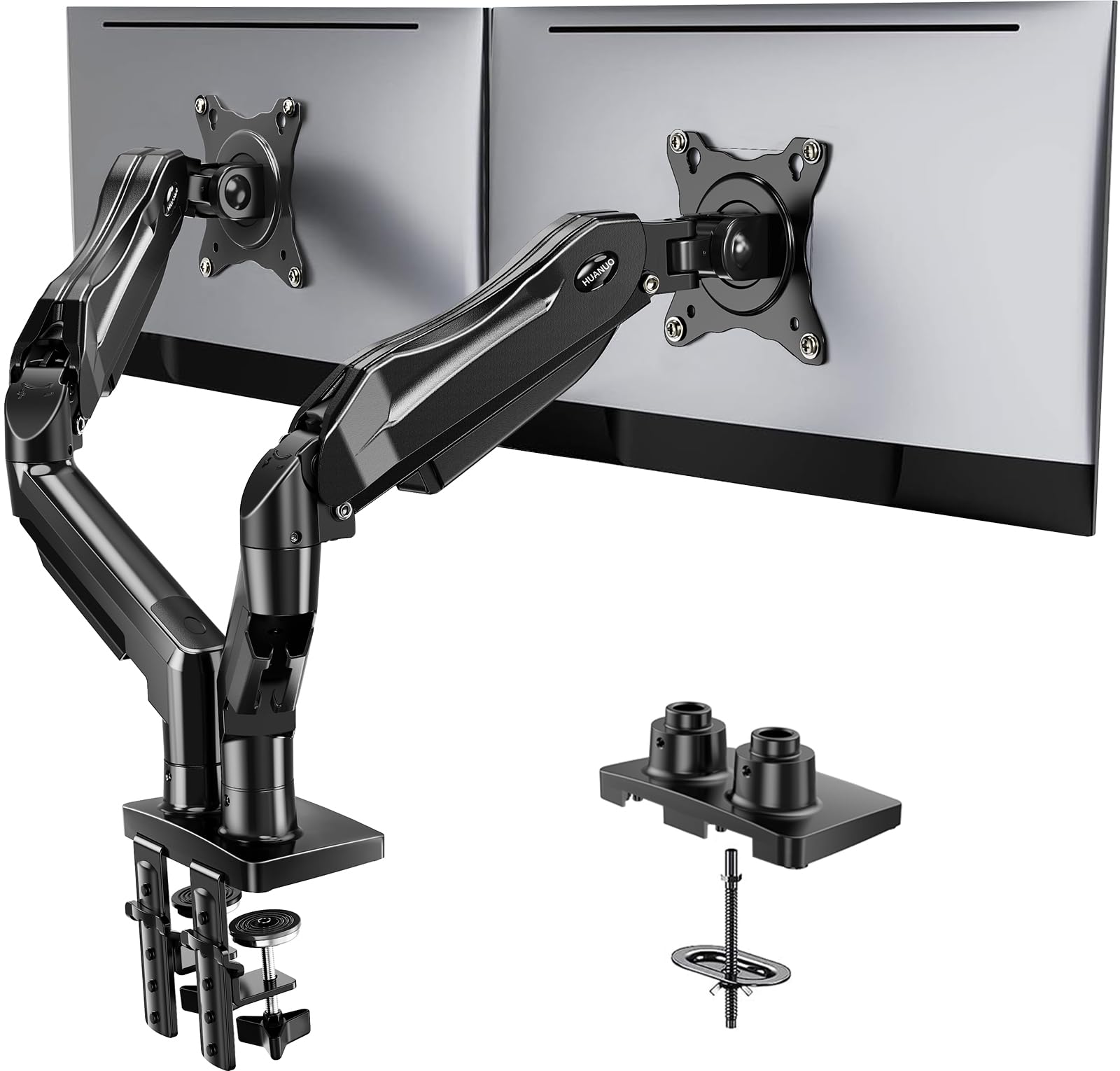
- Fits 13–32-inch screens weighing 4.4 to 19.8 lb each.
- Provides +85°/-50° tilt, ±90° swivel, and 360° rotation.
- Offers C-clamp or grommet installation and built-in cable management.
Best For: Users who want full-motion positioning for two compatible screens on a wooden desk.
HUANUO Stacked Dual Monitor Stand
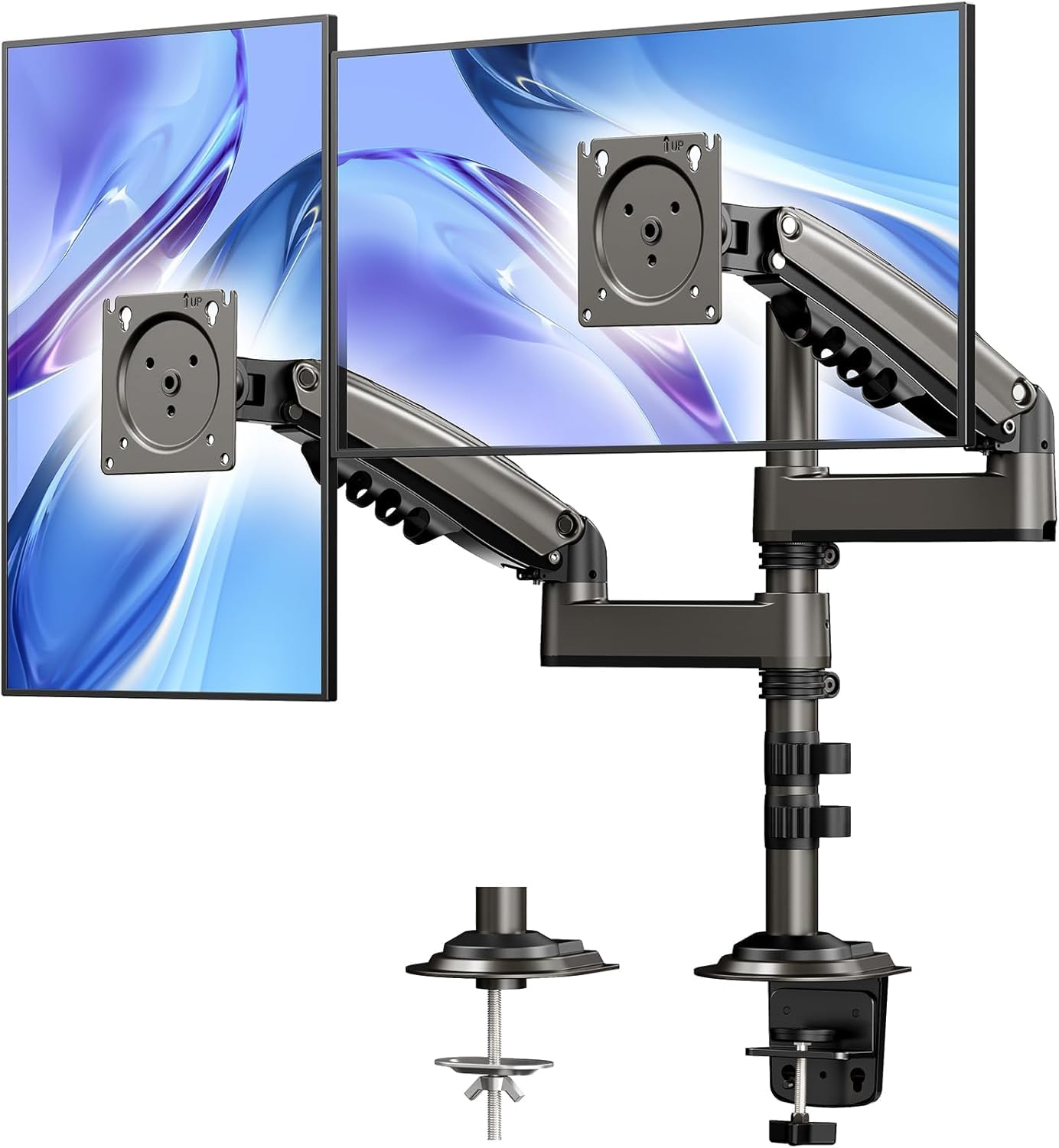
- Stacks two screens vertically and raises them up to 25.19 inches.
- Supports screens up to 32 inches and 19.8 lb each.
- Allows C-clamp or grommet mounting on compatible desks.
Best For: People who prefer vertically stacked screens and need extra monitor height.
HUANUO FlowLift Pro Dual Monitor Mount
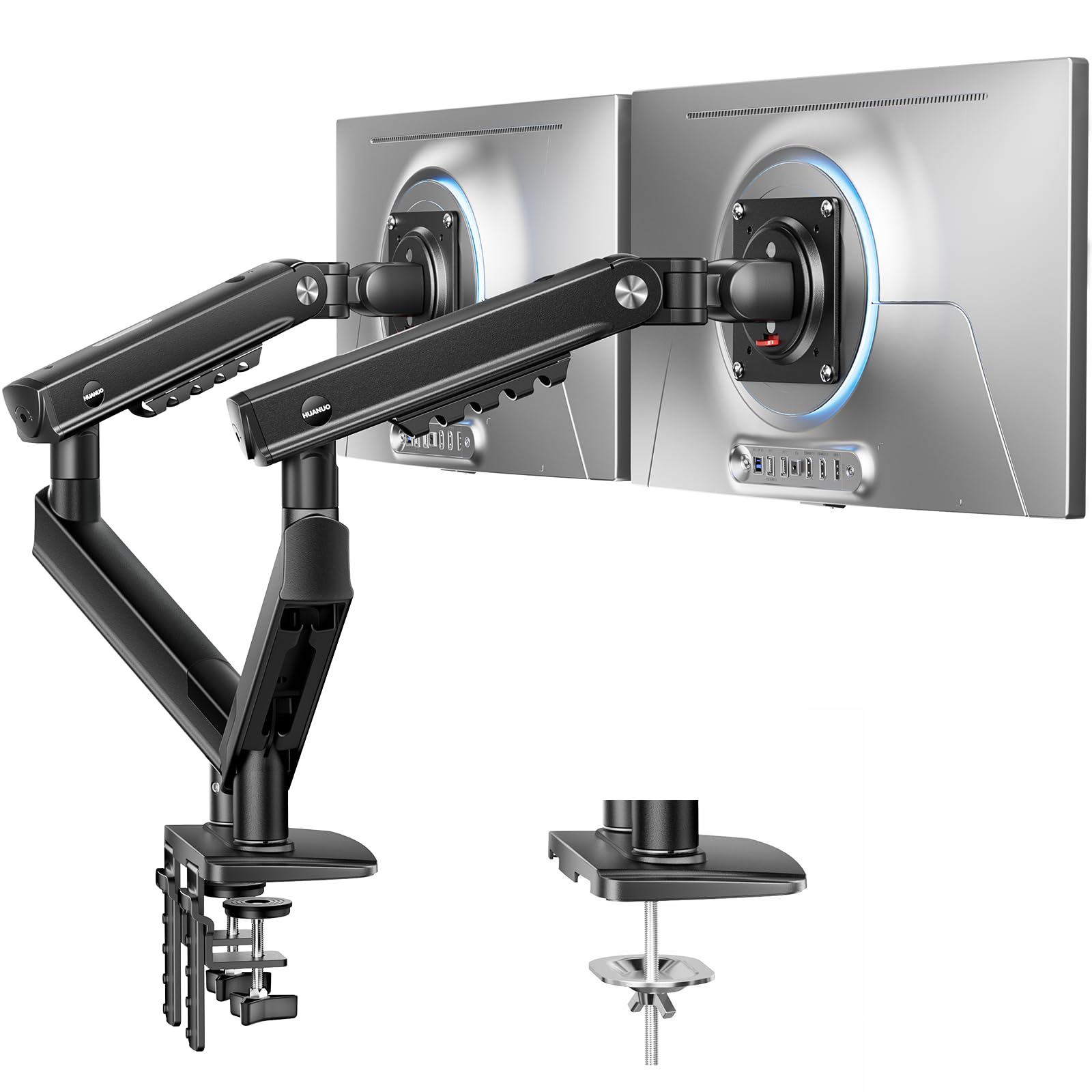
- Fits 13–27-inch screens weighing 4.4 to 15.4 lb each.
- Uses a tool-free InstaMount VESA plate.
- PrecisionView provides visual feedback during tension adjustment.
Best For: Users with lighter, smaller monitors who want quick VESA attachment and visible tension adjustment.
HUANUO TitanLift Heavy Duty Monitor Arm
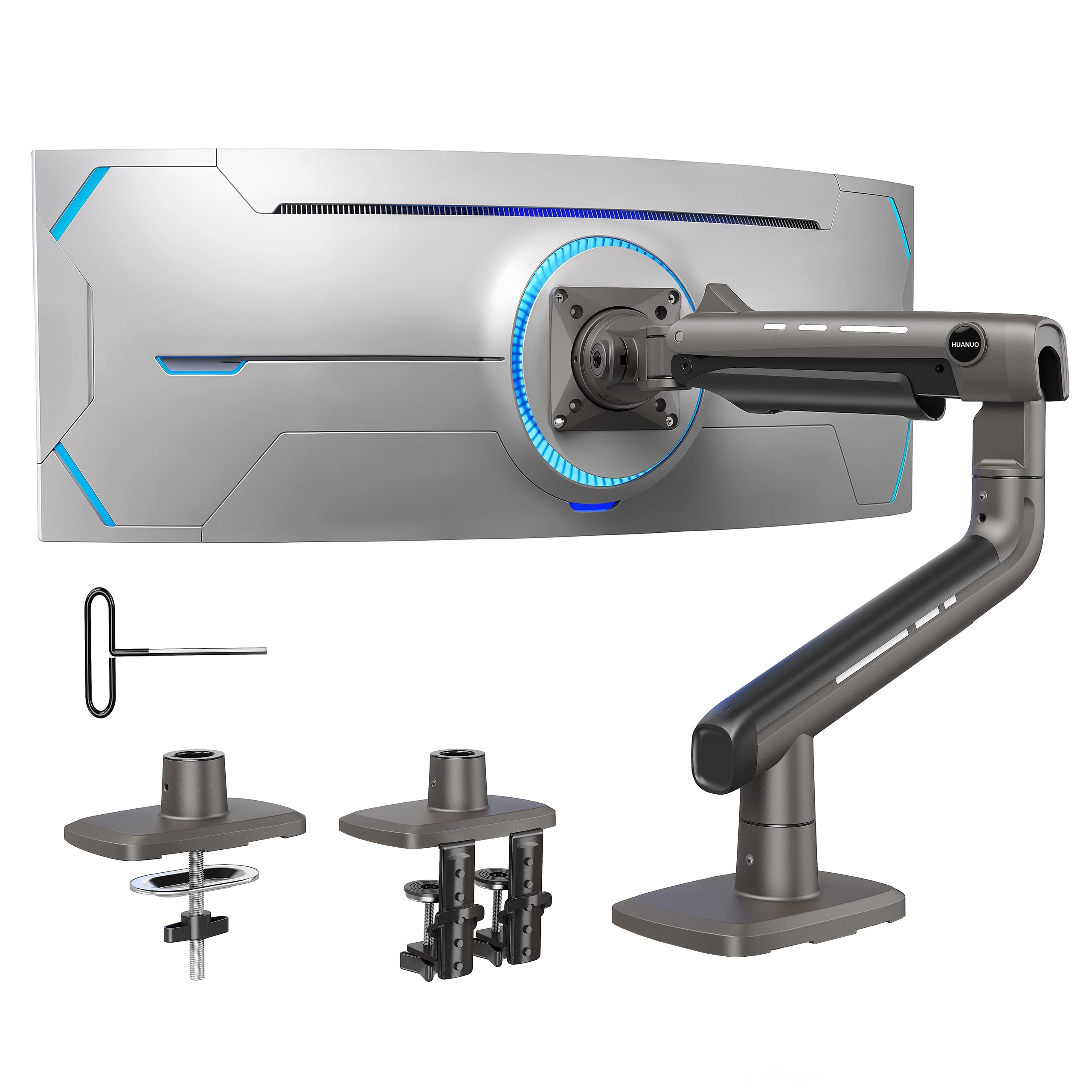
- Supports one 17–49-inch screen weighing 6.6 to 44 lb.
- Extends up to 22.5 inches and adjusts in height up to 19.6 inches.
- Includes a dual C-clamp and built-in cable management.
Best For: A buyer seeking a heavy-duty arm for one ultrawide display rather than two separate monitors.
Heavier Screens and Built-In USB
HUANUO Dual Monitor Stand for 13″–40″, Premium Dual Monitor Mount with USB, Height Adjustable Monitor Stand for 2 Monitors, VESA Mount with Clamp/Grommet Base, Holds 26.4lbs per Arm, HNDS7
The HUANUO HNDS7 supports two 13–40-inch monitors weighing up to 26.4 lb per arm, making it the broadest fit here for larger and heavier dual-screen setups. Its arms raise up to 21.1 inches and extend up to 25.59 inches, while tilt, swivel, and rotation give you several ways to position the displays.
Two built-in USB ports and a 5.25 ft cable add convenient charging access. The tradeoff is a larger fit checklist: confirm VESA compatibility, desk thickness, and grommet-hole size if you plan to bolt it through the desk.
Best For: People mounting larger, heavier displays who also want USB ports at the desk.
| Pros | Cons |
|---|---|
|
|
Choose the HNDS7 when screen size or weight rules out lighter-duty options, or when USB charging on the mount is useful. Its reach and height also give more placement flexibility for larger desks.
Before buying, verify each display falls within the size and weight limits and has a supported VESA pattern. Check desk thickness and grommet-hole dimensions if using that mounting method.
Flexible Side-by-Side Positioning
HUANUO FlowLift™ Dual Monitor Stand, Fully Adjustable Gaming Monitor Desk Mount for 13–32″ Computer Screens, Full Motion VESA 75x75/100x100 with C-Clamp & Grommet Base, Each Arm Holds 4.4 to 19.8 lbs
The HUANUO FlowLift is a side-by-side dual monitor stand for 13–32-inch screens weighing 4.4 to 19.8 lb each. Its arms tilt, swivel, and rotate through a broad range, and the screens can rise up to 15.75 inches.
Built-in cable management routes cords along the arms, while clamp or grommet installation gives two mounting choices. Desk compatibility is more restrictive than the mounting options may suggest: the notes recommend wooden desks and rule out plastic or glass, so check the desktop material, thickness, underside clearance, and monitor VESA pattern before ordering.
Best For: Users who want full-motion positioning for two compatible screens on a wooden desk.
| Pros | Cons |
|---|---|
|
|
This FlowLift suits a standard two-screen setup when you want to reposition displays often and value cable routing. Its screen size and weight range cover many conventional monitors, but are narrower than the other option’s limits.
Check the exact monitor weight, VESA holes, desk thickness, and underside before choosing it. The wooden-desk restriction is especially relevant if your workstation has a glass, plastic, or obstructed top.
Tall Stacked Display Layout
HUANUO 17-32 Inch Dual Monitor Stand, Vertical Dual Monitor Mount, Monitor Stand 2 Monitors, Ergonomic Adjustable Tilt/Swivel/Rotate, Weight Max 19.8 lbs, VESA 75/100mm
This HUANUO mount places two monitors in a vertical stack, with a 17-inch extension that raises screens up to 25.19 inches. It fits screens up to 32 inches, with a supported weight range of 4.4 to 19.8 lb per monitor and VESA 75×75mm or 100×100mm mounting.
Tilt, swivel, and rotation let you fine-tune viewing angles, and the mount supports either a C-clamp or grommet installation. The taller arrangement can suit a desk where side-by-side placement is inconvenient, but confirm that the monitors and desk meet the compatibility requirements before committing to a stacked layout.
Best For: People who prefer vertically stacked screens and need extra monitor height.
| Pros | Cons |
|---|---|
|
|
Pick this model if a vertical stack fits your workflow better than two screens spread across the desk. Its tall extension is the distinguishing feature, while its monitor weight range is similar to the FlowLift.
Confirm that both screens have compatible VESA holes and fall within the supported size and weight limits. Also check desk thickness and mounting clearance, then consider whether the vertical arrangement suits your viewing habits.
Tool-Free Screen Attachment
HUANUO FlowLift Pro Dual Monitor Mount for 13–27" Screens, MechaSpring Monitor Stand, Adjustable Monitor Arms for 2 Monitors with Tilt/Swivel/Rotation, Tool-Free VESA Mount, Max Load 15.4 lbs
The FlowLift Pro is sized for two smaller monitors within its listed screen size and weight range. Its tool-free InstaMount VESA plate is designed to make attaching or removing a screen simpler, and the PrecisionView window gives a visual indication while you adjust arm tension.
The mount also offers full-motion positioning and a dual C-clamp. This option is aimed at lighter displays than the other options, and its desk guidance recommends wooden tops.
Verify monitor weight and mounting pattern, along with desk material and thickness, before choosing it.
Best For: Users with lighter, smaller monitors who want quick VESA attachment and visible tension adjustment.
| Pros | Cons |
|---|---|
|
|
Choose the FlowLift Pro for smaller, lighter screens if easy VESA attachment and a visible tension indicator matter to you. Its monitor range is more limited than the standard FlowLift, so weigh each display and check its size before buying.
The notes also advise against other desk types, so confirm the desktop material and thickness. Its feature set is most useful when you expect to adjust or detach screens.
Single Ultrawide Screen Support
HUANUO TitanLift Heavy Duty Monitor Arm for Screens up to 49", Holds 44 lbs, Aluminum Ultrawide Screen Monitor Mount, Fully Adjustable Single Gaming Desk Mount with Dual C-Clamp, Max VESA 100x100mm
The TitanLift is the only single-screen arm in this group, designed for a 17–49-inch display weighing 6.6 to 44 lb. It offers up to 22.5 inches of extension and 19.6 inches of height adjustment, with tilt, swivel, and rotation; rotation is specified for screens up to 35 inches.
A dual C-clamp secures it to a compatible wooden desk, and cable management keeps wiring organized. It does not hold two separate monitors, so consider it only if your dual-screen goal can be met with one ultrawide display.
Check the desk and VESA fit carefully.
Best For: A buyer seeking a heavy-duty arm for one ultrawide display rather than two separate monitors.
| Pros | Cons |
|---|---|
|
|
This arm belongs on the list only for someone using one ultrawide screen as an alternative to two displays. It supports a much heavier single monitor than the dual arms, but cannot mount a pair of independent screens.
Check that the monitor has VESA 75×75mm or 100×100mm holes and that the desk is wooden, within the supported thickness, and clear underneath. Also account for the stated rotation limit.
How to Choose Dual Monitor Arms
How We Picked Dual Monitor Arms
The candidates needed to support two monitors and offer a practical desk-mount setup. We compared their stated screen-size and weight ranges, VESA patterns, mounting methods, and adjustment features, then separated distinct use cases: broad support for larger displays, full-motion side-by-side arms, a tall stacked mount, and a compact mount with tool-free VESA attachment.
The TitanLift is included as a single-ultrawide alternative and is clearly identified as such; it is not a dual-monitor arm.
Comparing Dual Monitor Arms
The HNDS7 supports the largest and heaviest pair among the dual-screen choices and adds two USB ports. The standard FlowLift covers screens up to 32 inches and has full-motion adjustment, while the FlowLift Pro is limited to smaller and lighter displays but adds a tool-free VESA plate and visible tension feedback.
For a vertical arrangement, the HUANUO stacked mount reaches up to 25.19 inches. The TitanLift serves a different purpose: it holds one large ultrawide, not two monitors.
| Product | Standout features | Best for |
|---|---|---|
| HUANUO HNDS7 Dual Monitor StandCheck Price |
| People mounting larger, heavier displays who also want USB ports at the desk. |
| HUANUO FlowLift Dual Monitor StandCheck Price |
| Users who want full-motion positioning for two compatible screens on a wooden desk. |
| HUANUO Stacked Dual Monitor StandCheck Price |
| People who prefer vertically stacked screens and need extra monitor height. |
| HUANUO FlowLift Pro Dual Monitor MountCheck Price |
| Users with lighter, smaller monitors who want quick VESA attachment and visible tension adjustment. |
| HUANUO TitanLift Heavy Duty Monitor ArmCheck Price |
| A buyer seeking a heavy-duty arm for one ultrawide display rather than two separate monitors. |
Check Monitor Fit and VESA Compatibility
Before buying a dual monitor mount, check each display separately. Screen size alone is not enough: compare its weight with the arm’s supported range and verify the rear mounting pattern.
Several options here require VESA 75×75mm or 100×100mm holes. For screens with unusual backs or stands, confirm that the mounting plate can attach before planning the desk layout.
Match the Mount to Your Desk
Desk thickness and underside clearance affect whether a C-clamp can attach securely. Some models also support grommet installation, which depends on the hole size; the HNDS7 gives a specific compatible diameter range.
Desk material guidance varies, and the FlowLift and FlowLift Pro recommend wooden desks. Check for cross beams, panels, or an irregular edge near the planned mounting point, since these can prevent installation.
Choose Height, Reach, and Screen Layout
A side-by-side dual monitor arm lets you position screens across the desk, while a stacked dual monitor mount places one above the other and raises the displays higher. Consider how much arm reach you need, where the screens sit relative to your working position, and whether portrait rotation or frequent repositioning matters.
The HNDS7 offers extra reach for deeper desks, while the stacked HUANUO is the height-focused option.
Who Should Buy Which Dual Monitor Arm?
Choose the HNDS7 for larger or heavier paired displays and built-in USB ports. The standard FlowLift fits many mid-size monitors and offers broad adjustment, while the FlowLift Pro fits lighter screens and adds tool-free VESA attachment.
Pick the stacked model when a vertical layout and extra height suit your workspace. Choose the TitanLift only if one ultrawide screen meets your needs in place of two separate monitors.